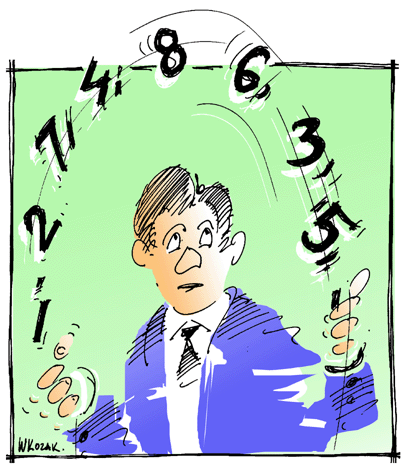
A recent study by Fournaise found that almost 75% of all CEOs believe marketers lack credibility. They think marketers place too much emphasis on brand values and brand equity without enough measurable data to prove how marketing drives revenue.
![]() Will someone who feels this way please define success for me? Define love. Define the shade of gray. If I got 100 definitions for each, they would all be different. My point is that success, love and shades of gray are all subjective, yet the diversity of the definitions doesn't make them any less valid or accurate.
Will someone who feels this way please define success for me? Define love. Define the shade of gray. If I got 100 definitions for each, they would all be different. My point is that success, love and shades of gray are all subjective, yet the diversity of the definitions doesn't make them any less valid or accurate.
Marketing is a science that requires both creativity and access to data to accurately measure ROI. Yes, sometimes measurement can be subjective, but often thats because the research needed to quantify its impact can take a significant amount of time or isn't given the proper infusion of resources (financial or otherwise). I can think of several companies (Amazon, Sony, Ford) that didn't make money coming out of the box. It was continuous product development and marketing that ultimately led to their success.
While I agree that every company should demand marketers understand and measure ROI and its impact on P & L, companies must also be willing to invest in the tools necessary to collect the required data. If not, what analytics do CEOs want marketers to use? The number of daily sales isn't a very accurate way to measure ROI if you don't know how many people are entering the store.
Additionally, the success of a marketing campaign can be directly impacted by internal or external variables that are often out of control of the marketing department. A campaign might increase store traffic by 100%, but if inventory management is poor, that campaign may have no impact on sales.
A good marketer will experiment with new communication channels like social media to determine their effectiveness, just as a medical researcher will experiment with a new drug to determine its effectiveness. There are no guarantees that either will work. So should a smart company just sit back and wait until the competition is effectively utilizing a new channel before making the decision to invest in it? They could, but then they'd be fighting an uphill battle trying to win back the loyalty of the customers they lost to the competitor who was innovative enough to try something new. We invest in research for new designs, new products and new systems every day without knowing what the outcomes will be. Business requires calculated risk. Marketing needs to be included in that equation.
Viewing marketers as lacking credibility is commonly the result of not understanding the science of marketing or not placing the proper emphasis on marketing. Often companies will expect champagne results on beer budgets. But when goals aren't met, how often is the budget looked at as the problem? I'm willing to bet not as often as the people.
That is not to say that there aren't bad marketers out there who try to avoid quantifying their value. I don't trust those guys anymore than the CEOs in the Fournaise study do. Though I don't think the problem is any greater in marketing than in any other profession. Can the value of HR or IT be quantified? It's hard to do, but they are still valuable and necessary. I've worked with many colleagues and business partners who weren't worth the paper their paychecks were written on, and I can think of several occasions when the marketing department bailed out other divisions without getting the credit it was due.
Marketing & ROI measurement should always go hand in hand, but expecting it without providing the proper tools and a willingness to take calculated risks is neither smart nor sustainable.
So before CEOs view marketers as lacking credibility, perhaps they should take the time to understand and invest in marketing first. I'm willing to bet that those who do are probably not reflected in the 73% identified in the study.
 Will someone who feels this way please define success for me? Define love. Define the shade of gray. If I got 100 definitions for each, they would all be different. My point is that success, love and shades of gray are all subjective, yet the diversity of the definitions doesn't make them any less valid or accurate.
While I agree that every company should demand marketers understand and measure ROI and its impact on P & L, companies must also be willing to invest in the tools necessary to collect the required data. If not, what analytics do CEOs want marketers to use? The number of daily sales isn't a very accurate way to measure ROI if you don't know how many people are entering the store.
Additionally, the success of a marketing campaign can be directly impacted by internal or external variables that are often out of control of the marketing department. A campaign might increase store traffic by 100%, but if inventory management is poor, that campaign may have no impact on sales.
A good marketer will experiment with new communication channels like social media to determine their effectiveness, just as a medical researcher will experiment with a new drug to determine its effectiveness. There are no guarantees that either will work. So should a smart company just sit back and wait until the competition is effectively utilizing a new channel before making the decision to invest in it? They could, but then they'd be fighting an uphill battle trying to win back the loyalty of the customers they lost to the competitor who was innovative enough to try something new. We invest in research for new designs, new products and new systems every day without knowing what the outcomes will be. Business requires calculated risk. Marketing needs to be included in that equation.
Viewing marketers as lacking credibility is commonly the result of not understanding the science of marketing or not placing the proper emphasis on marketing. Often companies will expect champagne results on beer budgets. But when goals aren't met, how often is the budget looked at as the problem? I'm willing to bet not as often as the people.
That is not to say that there aren't bad marketers out there who try to avoid quantifying their value. I don't trust those guys anymore than the CEOs in the Fournaise study do. Though I don't think the problem is any greater in marketing than in any other profession. Can the value of HR or IT be quantified? It's hard to do, but they are still valuable and necessary. I've worked with many colleagues and business partners who weren't worth the paper their paychecks were written on, and I can think of several occasions when the marketing department bailed out other divisions without getting the credit it was due.
Marketing & ROI measurement should always go hand in hand, but expecting it without providing the proper tools and a willingness to take calculated risks is neither smart nor sustainable.
So before CEOs view marketers as lacking credibility, perhaps they should take the time to understand and invest in marketing first. I'm willing to bet that those who do are probably not reflected in the 73% identified in the study.